From seasonal Maharashtrian vegetables and freshly prepared dals to the quiet ritual of a shared meal, discover how sattvic food in India can bring another dimension to a yoga retreat.
There is a particular pleasure in sitting down to a meal that has been prepared with care.
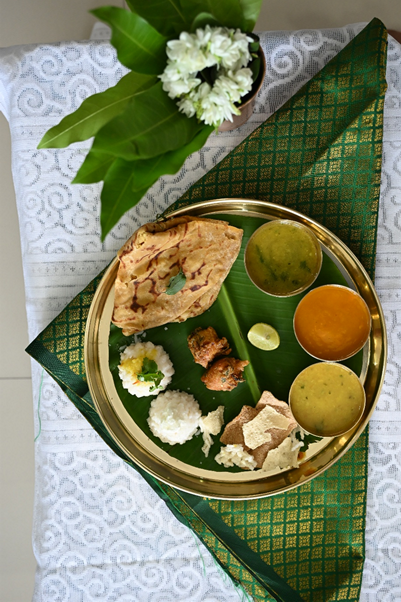
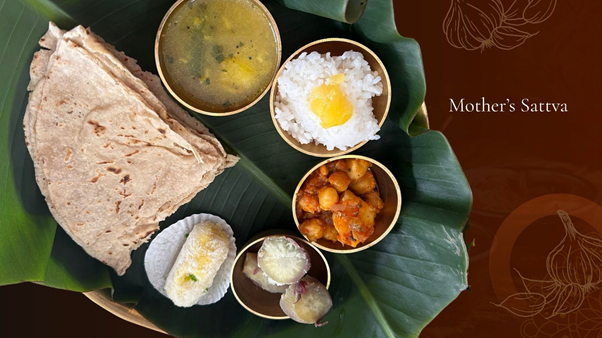
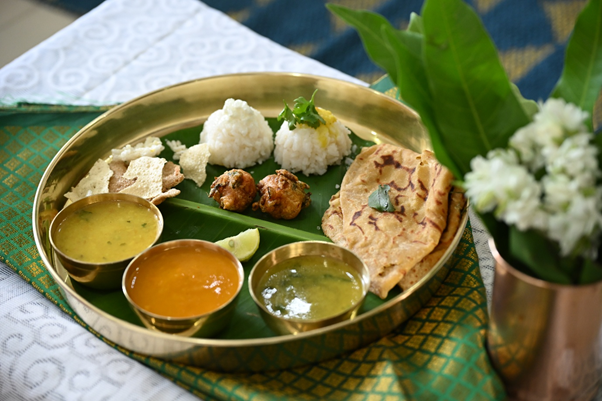
The vegetables are fresh, the spices are measured rather than overwhelming, and the food arrives warm from the home kitchen. Perhaps there is a bowl of dal, a seasonal vegetable preparation, soft chapatis and a little homemade chutney. Outside, the morning is beginning to warm, or the evening light is fading over the garden.
Nothing about the meal needs to be elaborate. Its appeal lies in the attention given to it.
For travellers coming to India to study yoga, explore Ayurveda or experience a different rhythm of life, food can become an important part of the journey. It offers a way to encounter the country’s traditions through its ingredients, regional cuisines, cooking methods and everyday rituals.
One concept that often arises in this context is sattvic eating—a traditional approach to food associated with clarity, moderation, balance and mindful living in Indian philosophical and yogic traditions.
At Swasti Yoga Center in Pune, the idea behind a thoughtful food experience is not simply to serve vegetarian meals. It is to introduce guests to Indian food culture with personal attention, an appreciation of regional traditions and consideration for individual preferences.
Because a meaningful meal is not only about what is on the plate. It is also about how it is prepared, where the ingredients come from and the care with which it is shared.
What does sattvic eating mean?
The Sanskrit word sattva is associated with qualities such as clarity, harmony and balance. In Indian philosophical traditions, particularly discussions of the three gunas—sattva, rajas and tamas—food is sometimes understood in relation to the qualities it is believed to encourage.
The Bhagavad Gita, in Chapter 17, verses 8–10, describes different categories of food in relation to these qualities. Later yogic and Ayurvedic traditions also discuss food in the context of daily conduct, digestion, individual constitution and the wider pursuit of wellbeing.
In many contemporary yoga settings, sattvic eating generally emphasises food that is fresh, appropriately prepared, nourishing and moderate in quantity. Meals may feature seasonal vegetables, grains, pulses, fruit, nuts, seeds and mild spices. Many interpretations favour vegetarian food and limit heavily processed ingredients, excessive pungency and food considered stale or excessively stimulating.
However, there is no single menu followed by every Indian household or every yoga tradition. Interpretations of sattvic eating vary by lineage, region, practitioner and individual circumstances.
Its practical value for a retreat guest may be simpler: it offers an opportunity to eat with greater awareness, explore traditional ingredients and consider the relationship between food, routine and personal wellbeing.
Why food matters during a yoga retreat
A yoga and wellness retreat often changes the structure of an ordinary day.
There may be an early morning practice, a period of study, a walk outdoors, an afternoon session or time set aside for rest. Meals become part of this rhythm, rather than something fitted hurriedly between appointments.
A retreat can offer a variety of freshly prepared foods, sensible meal timings and opportunities to understand traditional ingredients. Guests can learn how Indian households combine grains, pulses, vegetables, dairy where appropriate and spices to create meals with different flavours and textures.
It is to make food part of the learning experience while respecting the fact that people arrive with different bodies, routines, preferences and nutritional needs.
The ingredients: seasonal, local and full of character
One of the most rewarding ways to explore sattvic food in India is to begin with the ingredients themselves.
Maharashtra’s food traditions are shaped by its geography, climate, agricultural practices and regional diversity. Pune, situated on the Deccan Plateau, offers access to ingredients that vary with the season and the surrounding agricultural landscape.
A thoughtful kitchen can use this variety to introduce guests to local food culture.
Seasonal vegetables
Vegetables such as gourds, pumpkin, okra, aubergine, green beans and leafy greens appear in different combinations across Indian regional cuisines. Their availability and quality vary through the year.
Rather than expecting the same menu every day, visitors can discover how cooks adapt recipes to what is fresh and locally available. A simple vegetable preparation may use mustard seeds, cumin, turmeric, curry leaves or fresh coriander to develop flavour without relying on elaborate sauces.
Seasonal cooking is also an invitation to notice differences: the texture of a vegetable, the aroma of freshly ground spices or the way a cooking method changes its flavour.
Local sourcing can support nearby producers and reduce some transport requirements, although the environmental impact of a meal depends on more than distance alone. Production methods, storage, waste and seasonality all matter.
Pulses, dals and legumes
Dal is one of the most familiar foundations of Indian home cooking. Lentils and other pulses provide protein, fibre and important micronutrients, making them valuable components of many vegetarian diets.
Different varieties produce different textures and flavours. A lightly seasoned moong dal, a thicker preparation of toor dal or a bowl of masoor dal can each form part of a meal alongside vegetables and grains.
For visitors unfamiliar with Indian cooking, learning how pulses are soaked, cooked and seasoned can be a practical introduction to everyday food traditions.
People who are not accustomed to eating large amounts of legumes may prefer smaller portions initially, especially if they experience digestive discomfort. Cooking methods, portion sizes and individual tolerance all matter.
Grains and traditional breads
Rice, wheat and millets have long featured in different parts of India, with local preferences shaped by climate, agriculture and culture.
In Maharashtra, jowar bhakri is a familiar regional preparation, while wheat chapatis, rice and other grain-based dishes are also common. Millets such as bajra appear in traditional regional cooking, particularly in certain seasons and rural food cultures.
These ingredients offer opportunities to discuss how food traditions respond to local growing conditions and how different grains can contribute to a varied diet.
Gluten-free requirements deserve particular attention. Jowar and bajra are naturally gluten-free grains.
Spices, herbs and the art of restraint
Indian cooking is sometimes imagined as a succession of intensely spicy dishes. In reality, regional cooking includes a wide range of flavours, from mild and delicate to robust and fiery.
Cumin, coriander, turmeric, ginger, cardamom, cinnamon and fresh herbs can be used to create different aromatic profiles. Their quantities and combinations depend on the recipe, the season and the preferences of the people eating.
In a retreat kitchen, the art is often in proportion. Spices should complement the ingredients rather than overwhelm them.
Guests can also learn that a traditional ingredient does not automatically function as a medicine. Spices are part of culinary heritage, and although some have been studied for biological effects, ordinary culinary use should not be confused with a clinically effective treatment.
A taste of Maharashtra: Regional food beyond the familiar curry
A food experience in Pune offers an opportunity to discover the variety of Maharashtrian cooking rather than relying on a generic menu labelled “Indian vegetarian.”
The state’s cuisine ranges from the coastal Konkan region to the drier interior of the Deccan Plateau. Ingredients, techniques and preferred flavours change across these landscapes.
At a well-planned cooking session, visitors might encounter preparations such as:
Varan-bhaat: A familiar combination of dal and rice, often served as a simple home-style meal. Its appeal lies in the comfort of well-cooked ingredients rather than complexity.
Pithla-bhakri: A traditional preparation made with gram flour, often paired with bhakri. The dish demonstrates how a small number of ingredients can become a satisfying regional meal.
Seasonal bhaji: A vegetable preparation that varies according to the produce available. It can introduce guests to the use of local vegetables, spices and tempering techniques.
Koshimbir: A family of fresh salads and accompaniments that may include vegetables, herbs, yoghurt or other ingredients depending on the recipe.
Thalipeeth: A savoury flatbread made using a flour mixture that may include different grains and pulses. Recipes vary from household to household.
Regional chutneys and accompaniments: Preparations using ingredients such as peanuts, sesame, coconut or fresh herbs, depending on the region and recipe.
Not every dish traditionally eaten in Maharashtra is sattvic under every interpretation. Onion, garlic, fermented ingredients and particular spices may be excluded by some practitioners and included by others. A cooking class should explain these differences rather than presenting one version as the definitive Indian tradition.
This is part of the pleasure of learning to cook in India: discovering that a cuisine is not a fixed collection of recipes, but a living body of knowledge shaped by households, communities and generations.
The kitchen as a place of learning
An Indian vegetarian cooking class can be one of the most accessible ways for an international visitor to engage with local culture.
A well-designed session goes beyond watching a chef prepare a meal. Guests can learn how ingredients are selected, how spices are stored and used, how a tempering is prepared, why certain pulses are soaked, and how a meal is assembled from several complementary dishes.
The experience may begin with a visit to a local market or a discussion about seasonal produce, depending on what is available and practical. Back in the kitchen, the instructor can demonstrate a few preparations and explain the choices behind them.
For someone returning home after a yoga retreat, this practical knowledge has a lasting advantage: it can be adapted to an ordinary kitchen, with ingredients available locally.
The most useful cooking classes also encourage questions. What can replace an ingredient that is unavailable overseas? How can the same dish be prepared with less chilli? How can a recipe be adapted for a dairy-free diet? What makes one regional preparation different from another?
These questions turn a meal into an exchange of knowledge.
Ayurveda and food: Tradition, individual needs and responsible guidance
Food occupies an important place in Ayurveda, India’s traditional system of medicine. Ayurvedic approaches may consider digestion, appetite, daily routine, individual constitution and the qualities attributed to different foods.
An Ayurveda food workshop can introduce these concepts as part of India’s traditional knowledge systems, while helping visitors understand how food choices vary across individuals and contexts.
It is important, however, to distinguish educational discussion from individualised medical advice. Traditional concepts such as prakriti and agni belong to an Ayurvedic framework; they should not be presented as interchangeable with modern medical diagnoses or laboratory measurements.
Likewise, a meal described as Ayurvedic is not automatically appropriate for every person. People with diabetes, kidney disease, food allergies, gastrointestinal conditions or other medical needs may require specific dietary guidance. Those taking medication should not change their treatment or begin herbal products on the basis of a food workshop.
For international visitors, this balanced approach is particularly valuable. It allows them to explore traditional Indian food knowledge without being asked to abandon their existing healthcare or nutritional needs.
What does a sattvic day of eating look like?
There is no universal sattvic menu, and an appropriate meal plan depends on individual preferences, activity, nutritional needs and the tradition being followed. It follows the idea of Hara Hachi Bu or Mitahara (Limited diet) up to two-third of stomach capacity and no overeating.
A simple illustrative day might include:
Morning: A breakfast of poha with vegetables and peanuts, or another suitable grain-based preparation, accompanied by fruit if desired.
Midday: A meal of dal, rice or chapati, seasonal vegetables and an appropriate accompaniment. Portions can be adjusted to appetite and activity.
Afternoon: Fruit, nuts or another suitable snack, depending on hunger and the day’s schedule.
Evening: A comfortably portioned meal with cooked vegetables, a grain and a source of protein, adapted to the guest’s preferences and needs.
This is an example of a possible meal pattern, not a prescription or a claim that these foods are suitable for everyone. Guests with allergies, coeliac disease, diabetes or other dietary requirements need individual consideration, and the menu should be adjusted accordingly.
The deeper lesson is not that every meal must follow a rigid formula. It is that food can be approached with attention, moderation and respect for the needs of the person eating it.
Eating mindfully without turning food into a rulebook
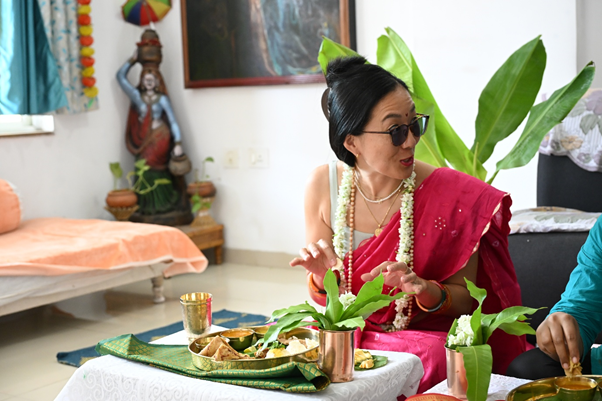
For some people, a yoga retreat introduces a new awareness of eating habits. A shared meal can offer a simple opportunity to slow down. Sit comfortably. Notice the flavours and textures. Allow time to eat without rushing. Pay attention to hunger and fullness without treating them as a test of discipline.
Mindful eating should not become another source of anxiety. There is no need to label every food as spiritually superior or morally inferior, or to feel that one meal has undermined a yoga practice.
Food has nutritional, social, cultural and personal dimensions. For many people, familiar foods, festive dishes and meals shared with family are important parts of wellbeing and belonging.
The art lies in finding a relationship with food that is informed, flexible and appropriate to one’s circumstances.
How Swasti Yoga Center approaches food and cultural immersion
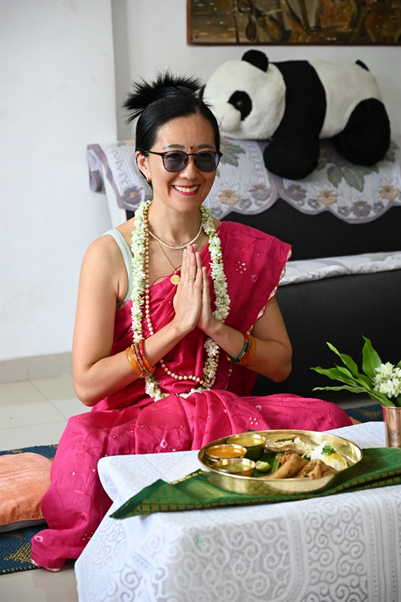
For visitors who want to experience Indian food as part of a broader cultural journey, Swasti Yoga Center in Pune offers a setting in which yoga education and engagement with Indian traditions can be brought together.
The guiding principles are personal attention, professional yoga education, authentic Indian culture and a quieter way to experience India.
A thoughtfully planned retreat can use these principles to shape conversations about food, yoga and daily routine around the interests of each guest. A visitor who is curious about Maharashtrian home cooking may want to learn a handful of regional recipes. Someone studying yoga may wish to understand the place of food in traditional yogic philosophy. Another traveller may simply want freshly prepared vegetarian meals and an opportunity to experience Indian hospitality.
Where available and confirmed in advance, tailored meals, Indian vegetarian cooking classes and Ayurveda food workshops can offer different ways to engage with these interests.
The important point is personalisation. Dietary preferences, allergies, cultural expectations, spice tolerance, accessibility and medical needs should be discussed before the experience is planned. Guests should also be told clearly what is included in a retreat and what requires a separate booking.
This is not about promising a perfect diet or a guaranteed outcome. It is about making room for a more considered experience of Indian food and culture.
Before booking: Questions worth asking
If food is an important part of your retreat, ask the organiser:
- Are meals included, and can menus be adapted to dietary requirements?
- Can you accommodate allergies, vegetarian or vegan preferences, and gluten-free needs?
- Are ingredients sourced locally or seasonally where practical?
- Does the cooking class include hands-on preparation or mainly demonstrations?
- Is the workshop focused on regional cuisine, sattvic cooking, Ayurvedic food traditions or a combination?
- Who leads the session, and what are their relevant qualifications?
- Are Ayurveda consultations or individual dietary recommendations separate services?
- Can you share any allergies or medical dietary requirements before arrival?
Clear answers help set realistic expectations and allow the experience to be planned responsibly.
Discover the culture of Indian food, one meal at a time
The art of sattvic eating is not simply a matter of removing certain ingredients or following a strict menu. At its most thoughtful, it is an invitation to consider food in relation to tradition, attention, routine and individual needs.
In Maharashtra, this exploration can begin with a familiar bowl of dal, a seasonal vegetable, a regional flatbread or a cooking technique passed down through generations. It can continue through conversations about Indian philosophy, local ingredients and the many ways food connects people to place.
For travellers visiting Pune, these experiences offer a way to engage with India beyond sightseeing. They make room for learning, conversation and the pleasure of a meal prepared with care.
Explore a more personal experience of Indian food and yoga with Swasti Yoga Center. Enquire about a personalised retreat, an Indian vegetarian cooking experience or an Ayurveda food workshop in Pune.