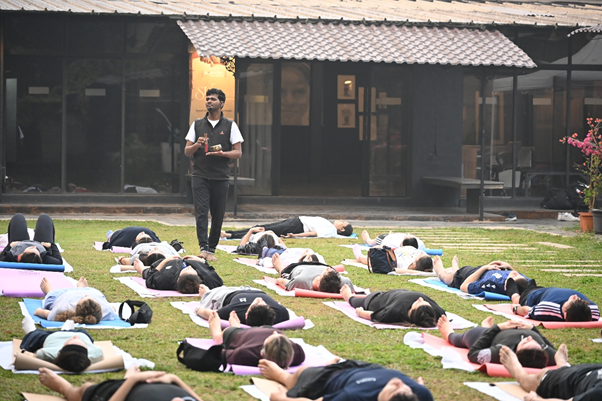
In a growing global wellness industry, a YCB-AYUSH certificate may open the door to a teaching career. What sustains it is the ability to teach with knowledge, clarity, sound judgement and responsibility.
Yoga has travelled far beyond the studio. It is practised in schools, workplaces, rehabilitation settings, community centres, private homes and retreat destinations across the world. As interest in yoga grows, so does the need for teachers who can do more than demonstrate postures or complete a training programme.
For aspiring teachers, the question is increasingly important: What does it really mean to be qualified to teach yoga?
A certificate can document that a person has completed a course or met the requirements of a particular assessment. Competence, however, is demonstrated in practice. It is the ability to translate knowledge into safe, effective, thoughtful teaching—and to recognise the limits of one’s own expertise.
The distinction matters not only to yoga teachers, but also to students, training institutions and employers seeking credible professional standards.
The certificate is the beginning, not the destination
A YCB-AYUSH certificate has genuine value. It can provide evidence of structured learning, identify the curriculum completed and, where applicable, demonstrate that a candidate has met the requirements of a recognised certification body.
But certificates do not all mean the same thing.
Consider two newly trained yoga teachers. Both have completed the same number of training hours and hold comparable credentials. One can explain the purpose of a practice, demonstrate it clearly, observe students and modify instructions when needed. The other can reproduce the sequence but struggles to recognise when a student is uncomfortable or confused.
Their certificates may look similar. Their teaching competence does not.
Six capabilities every professional yoga teacher should develop
A competent yoga teacher brings together theoretical knowledge, practical skill, communication, observation and professional judgement. These capabilities overlap; none can fully compensate for the absence of another.
1. Knowledge: understanding the principles behind the practice
A professional teacher needs more than a collection of postures.
They should understand relevant yoga concepts principles of asana and pranayama, sequencing, relaxation and meditation, and the philosophical foundations appropriate to their training. Depending on the programme, this may include the Yoga Sutras of Patanjali, the Bhagavad Gita, Hatha Yoga traditions and other relevant Indian knowledge systems.
Knowledge should inform teaching decisions. A teacher should be able to explain why a practice has been selected, identify its intended learning objective and distinguish traditional explanations from claims that require scientific evidence.
Professional competence also includes knowing what one does not know. A yoga teacher should not present themselves as a medical professional unless separately qualified, diagnose conditions outside their scope or promise that a particular practice will cure a disease.
The practical test: Can the teacher explain the purpose, principles and limitations of a practice and not merely name it?
2. Demonstration: showing the practice with clarity
Demonstration is a teaching skill, not simply a display of personal flexibility.
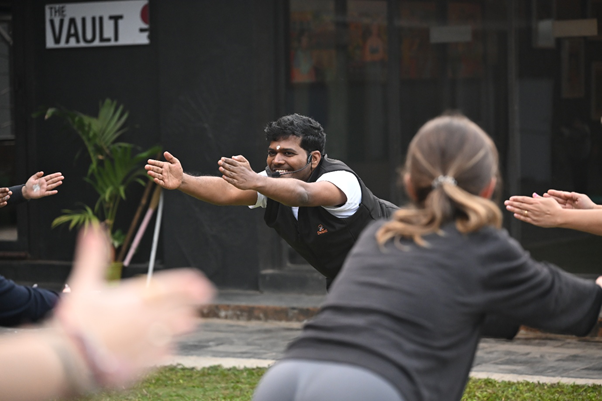
Teachers need to communicate the essential features of a practice through clear positioning, appropriate pacing, understandable instructions and relevant demonstrations. They should recognise that students have different levels of experience, mobility, balance, strength and confidence.
A professional demonstration does not have to be visually impressive. It has to make the learning objective understandable.
Equally important is the ability to teach without relying entirely on demonstration. In some settings, a teacher may need to give verbal instructions, describe movement in stages or offer alternatives that allow students to participate comfortably.
The practical test: Can a learner understand what to do, how to approach it and what to pay attention to?
3. Communication: turning knowledge into learning
Knowing a subject and teaching it are different competencies.
A yoga teacher must organise instructions in a logical sequence, choose language appropriate to the audience and explain unfamiliar concepts without unnecessary complexity. A class of beginners requires a different approach from a group of experienced practitioners. Children, older adults and corporate participants may need different teaching methods and communication styles.
Good communication also includes listening. Students may ask questions, misunderstand instructions or communicate discomfort indirectly. Teachers need to respond without embarrassment, impatience or pressure.
For international teaching, cultural sensitivity and accessible language become particularly important. Sanskrit terminology and Indian philosophical concepts can be introduced with respect for their origins while still being explained in ways that make sense to learners from different backgrounds.
The practical test: Can the teacher make a complex idea understandable and respond constructively when a student needs clarification?
4. Safety: recognising risks and respecting boundaries
A professional yoga class requires more than a well-planned sequence. It requires awareness of the people participating and the conditions in which the practice takes place.
Teachers should understand relevant contraindications and precautions within their training, provide appropriate options, monitor signs of discomfort and know when to stop or modify an activity. They should also understand the limitations of their qualifications and refer students to an appropriate healthcare professional when a concern falls outside their competence.
Safety includes professional conduct. Students should be treated respectfully, consent should guide any physical adjustments, and personal information should be handled appropriately. Teachers should avoid language that pressures participants to ignore pain or exceed their limits.
No training programme can eliminate every risk. Competence means recognising foreseeable risks, responding proportionately and creating conditions in which students can make informed choices.
The practical test: Can the teacher identify a concern, choose a proportionate response and explain when additional professional support may be necessary?
5. Observation: seeing what is happening in the room
Teaching is not a one-way performance. A teacher gives instructions, observes the response and adjusts the lesson accordingly.
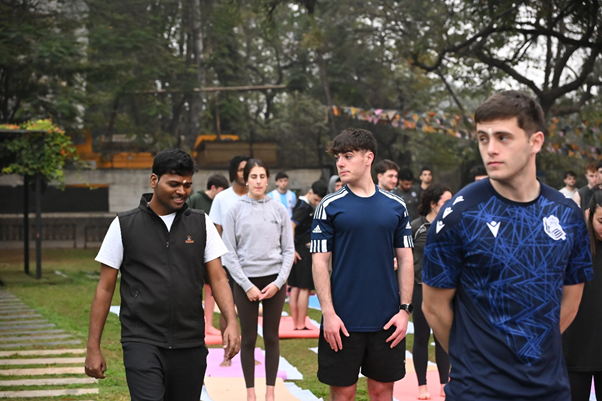
Observation includes noticing whether students understand the instructions, whether the pace is appropriate, whether a movement appears difficult or uncomfortable and whether the class is achieving its intended learning objective.
This requires attention to the whole group as well as to individual participants. A teacher who focuses exclusively on delivering a memorised sequence may miss important information about how students are responding.
Observation must also be approached carefully. A teacher can notice visible movement patterns or signs of discomfort, but should not assume that these observations establish a diagnosis.
The practical test: Can the teacher identify meaningful signs of how students are responding and use that information to make a sound teaching decision?
6. Adaptation: responding to real people, not an idealised student
A sequence that works well for one group may be unsuitable for another.
Adaptation means adjusting instructions, duration, intensity, posture options, props, pacing or the structure of a session to meet the learning objectives and the needs of participants. It also means understanding when a planned activity should be omitted.
For example, an older beginner may benefit from a chair-supported variation. A workplace session with limited space may require a different sequence from a residential yoga programme. A student who reports pain may need the teacher to stop an activity rather than simply offer a more difficult variation.
Specialist teaching requires additional preparation. Working with children, pregnant participants, older adults or people with specific health conditions calls for relevant knowledge, specialised diplomas, supervised practice where appropriate and a clear understanding of professional boundaries.
The practical test: Can the teacher adapt the session thoughtfully without losing sight of its purpose or exceeding their scope of practice?
Together, these six capabilities offer a more meaningful picture of professional readiness than training hours alone.
How does practical assessment turn learning into evidence?
If competence matters, it must be assessed.
Written examinations can test conceptual understanding, terminology and recall. They are useful, but they cannot independently establish whether someone can lead a class, communicate effectively or respond to an unexpected situation.
Practical assessment addresses this gap by observing the learner performing relevant teaching tasks.
A structured assessment may include:
- Lesson planning: Is the session organised around clear objectives, an appropriate sequence and the intended audience?
- Demonstration: Are instructions and demonstrations accurate, clear and appropriately paced?
- Teaching delivery: Can the learner manage transitions, time and the flow of a session?
- Observation and adaptation: Does the learner respond appropriately to students’ needs and feedback?
- Safety and professional conduct: Does the learner recognise relevant precautions, respect boundaries and remain within their scope of practice?
- Reflection: Can the learner identify strengths, acknowledge limitations and describe what should improve?
The precise assessment criteria should match the programme’s learning outcomes and level of responsibility. A beginner qualification and an advanced or specialist qualification should not be expected to demonstrate identical levels of expertise.
Why does feedback matter?
Assessment is most useful when it does more than produce a pass or fail result.
Specific feedback helps learners understand what they did well, where their performance fell short and what to practise next. A teacher who receives feedback on unclear instructions, for example, can rehearse more concise verbal cues and be assessed again. A learner who overlooks a safety consideration can study the relevant principle and demonstrate a more appropriate response.
For students choosing a training institution, useful questions include:
- How much supervised teaching practice is included?
- Are learners assessed while actually teaching?
- What criteria are used to evaluate practical performance?
- Is individual feedback provided?
- What happens if a learner has not yet met the required standard?
- Which certificate is issued by the institution, and which, if any, is awarded by an external certification body?
Clear answers help prospective teachers distinguish between a programme that primarily delivers content and one that also evaluates professional readiness.
Why does continuing education matter?
Completing an initial qualification is an important milestone. It is not the end of professional development.
Yoga teaching takes place across changing contexts, audiences and expectations. A teacher may begin by leading general group classes, then develop an interest in school wellbeing, workplace programmes, yoga for older adults, meditation education or other specialist areas.
Each direction requires further learning.
Continuing professional education can help teachers deepen their theoretical understanding, improve their instructional methods, learn from experienced faculty and reflect on their teaching. Workshops, advanced courses, supervised practice, peer observation and structured self-study can all contribute when they have clear learning objectives.
Experience alone does not automatically create expertise. Years of teaching can strengthen judgement, but only when experience is combined with reflection, feedback and a willingness to correct mistakes.
Specialisation should follow competence
Specialised yoga careers can create opportunities beyond conventional group classes. Potential settings include:
- Schools and educational institutions: age-appropriate movement, relaxation and wellbeing education.
- Corporate environments: accessible yoga sessions and workplace wellbeing programmes.
- Older-adult programmes: appropriately adapted practices that respect mobility, balance and individual needs.
- Retreats and cultural learning: yoga instruction combined with a thoughtful introduction to Indian philosophical and cultural traditions.
- Yoga therapy settings: work within a clearly defined scope, with relevant training and appropriate collaboration or referral to healthcare professionals.
These are different professional contexts, not interchangeable labels. A general yoga-teacher qualification should not be presented as automatically qualifying someone for clinical practice or every specialist population.
Teachers should evaluate the prerequisites, curriculum, supervised experience, assessment methods and recognition attached to any advanced course before enrolling.
Build a career, not just a collection of certificates
A sustainable professional pathway is more deliberate than accumulating qualifications.
It begins with foundational knowledge and teaching competence. It progresses through experience, feedback and further study. Specialisation follows when the teacher has developed the relevant skills and understands the responsibilities involved.
Career development also includes capabilities that are sometimes overlooked in yoga training: communicating with clients, planning programmes, managing schedules, maintaining professional boundaries, explaining the value of a service and evaluating whether a programme meets its stated objectives.
A capable teacher must be able to teach. A developing professional must also learn how to work responsibly, collaborate effectively and keep improving.
Building a professional career with Swasti Yoga Center
At Swasti Yoga Center in Pune, India, professional yoga education can be approached as a progression of learning rather than a single qualification.
Swasti offers training pathways associated with foundational yoga instruction, advanced teaching and evaluation, yoga master training, and specialist programmes. Depending on the learner’s background and goals, these may provide opportunities to build knowledge, refine teaching skills and explore areas of professional interest.
The relevant programme, eligibility criteria, learning hours, practical requirements, assessment process and certification arrangements should always be checked before enrolment. A Swasti course-completion certificate must be distinguished from a certificate issued by the Yoga Certification Board (YCB) or another external body. Any external certification is subject to that body’s applicable requirements and assessment; completing a preparation course does not by itself guarantee certification.
The real measure of a yoga teacher
A certificate can record an achievement. Competence is revealed in the quality of a teacher’s decisions.
It appears in the way a teacher explains a practice, observes a student, adapts an instruction, recognises a limitation and responds when a lesson does not go as planned. It is strengthened through assessment, feedback, experience and continued study.
For aspiring yoga professionals, the aim should not be to choose between credentials and competence. Credible credentials and demonstrated competence serve different but complementary purposes. One can document learning and recognised standards; the other shows how that learning is applied.
The strongest professional education brings them together.
Because the real measure of yoga education is not only what a teacher has studied, but what that teacher can responsibly bring into the room.
Take the next step with Swasti Yoga Center
If you are exploring a professional path in yoga, begin by identifying the kind of teacher you want to become. Review the programme’s learning outcomes, practical teaching requirements, assessment methods and credential arrangements before making a decision.
Explore the relevant training pathways at Swasti Yoga Center, Pune, and choose your next step with a clear understanding of the competence you want to develop.
Learn with purpose. Practise with discipline. Teach with responsibility.